Rainwater Catchment Filtration in Hawaii: A Simple Setup That Works
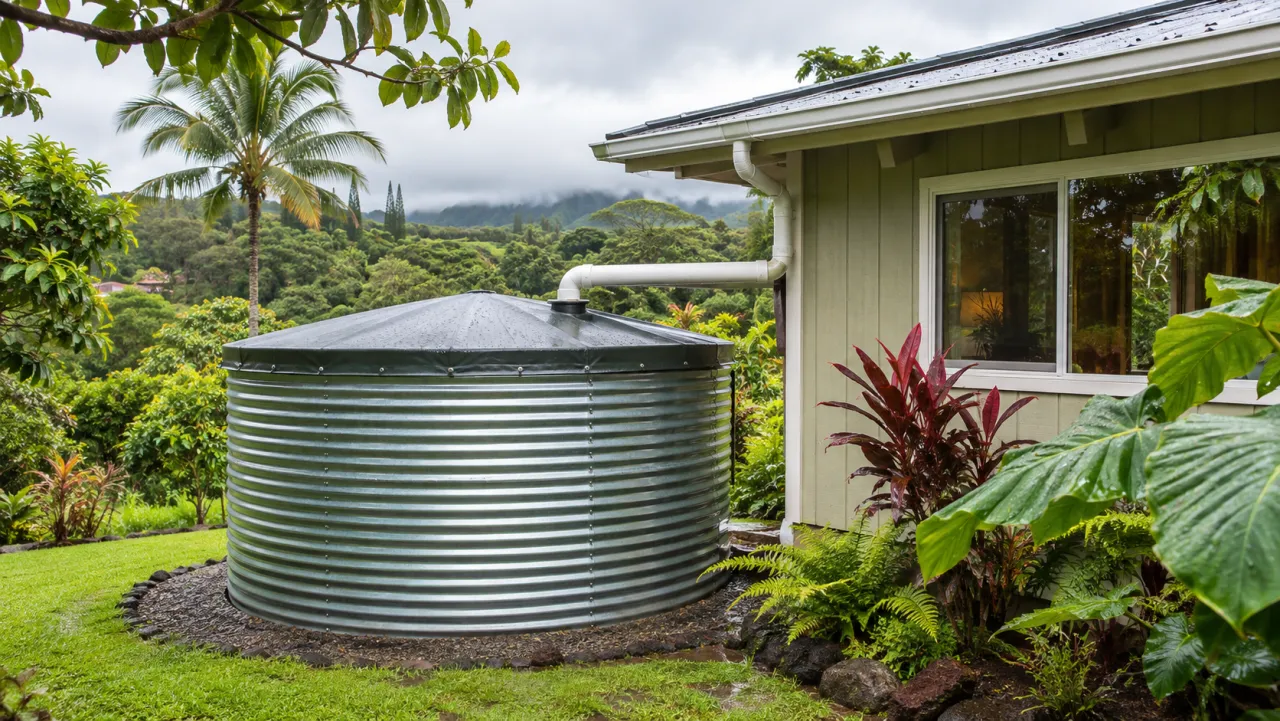
Thousands of homes in Hawaii run on rainwater catchment, especially in places like Haiku, Huelo and Hana on Maui and much of the Big Island. Catchment water can be excellent, but it is not treated by anyone but you. The State Department of Health does not regulate private household catchment systems. It points owners to the University of Hawaii’s Guidelines on Rainwater Catchment Systems for Hawaii, last revised in 2020.
This guide follows those guidelines and explains a filtration setup that is simple to live with.
Why catchment water needs filtering
Rain itself is clean. What it picks up on the way to your tap is the issue: dust, leaves and ash on the roof, bird and rodent droppings, slugs and snails in gutters and tanks, and sediment that settles in the tank over time. Some of these carry bacteria and parasites. In Hawaii, slugs and snails can also carry the parasite that causes rat lung disease, which is one reason covered tanks and good filtration matter here.
The setup, step by step
University of Hawaii extension materials describe filters as a series, each catching smaller particles than the one before. A typical home has a screen before the tank, a sediment filter after the pump and a fine filter at the sink.
1. Screens before the tank
Screens, foam, socks and cloth filters on gutters, downspouts and the tank inlet keep leaves, twigs and other large debris out. They are usually 60 microns and up. A first-flush diverter, which sends the dirtiest first rain away from the tank, helps too. Keep the tank covered and sealed so light, insects, slugs and animals cannot get in.
2. Sediment filter at the point of entry
After the pump, a sediment filter takes out visible particles such as silt, clay and ash. The University of Hawaii brochure lists these filters in the 1 to 30 micron range at the point of entry. Many homes use two sediment stages, a coarser one followed by a finer one, so the fine filter does not clog as quickly.
3. Carbon filter
Charcoal and carbon block filters, typically 1 to 10 microns, reduce bad taste, odor and some chemicals and metals. They can go at the point of entry, at the point of use, or both.
4. Disinfection
This is the step people most often skip. Filters are not enough on their own. In the University of Hawaii’s words, most filters “do not remove disease-causing organisms. They enable your disinfection systems to work more effectively.”
Ultraviolet (UV) disinfection is a common choice for catchment homes. It goes after the filters, because particles in the water can shield microorganisms from the UV light. That is another job the sediment and carbon stages do: they make the UV system work. Size the UV unit for your household’s flow rate.
5. A fine filter for drinking water
For drinking and cooking water, many homes add an absolute 1 micron filter at the kitchen sink. The University of Hawaii notes these are designed to keep protozoan cysts out of the water, and that point-of-use filters at 1 micron or less are built to remove the cysts and nematodes behind illnesses like giardiasis and rat lung disease. They do not remove bacteria or viruses, so they work alongside disinfection, not instead of it.
When to change your filters
Follow the manufacturer’s schedule, but expect your results to vary with how much water you use and how clean it is to start. The University of Hawaii brochure says small filters usually last about a month and large filters can last as long as six months.
Change filters when:
- the manufacturer recommends it,
- they look dirty or clogged, or
- your water pressure drops.
Reduced pressure is the most common sign of a clogged filter. Pressure gauges before and after your filters make this easy to see: when the difference between them grows, a cartridge is filling up. Do not wash filters that were not made to be washed. When you change a cartridge, clean out the housing too, because bacteria left in the housing will quickly contaminate the new filter.
Test your water
Even a well-maintained system should be tested. EPA summaries of Hawaii’s guidance list E. coli, turbidity, lead and copper as the basic screening tests. Test after you install a new system, after major repairs and on a regular schedule.
Where a whole house filter system fits
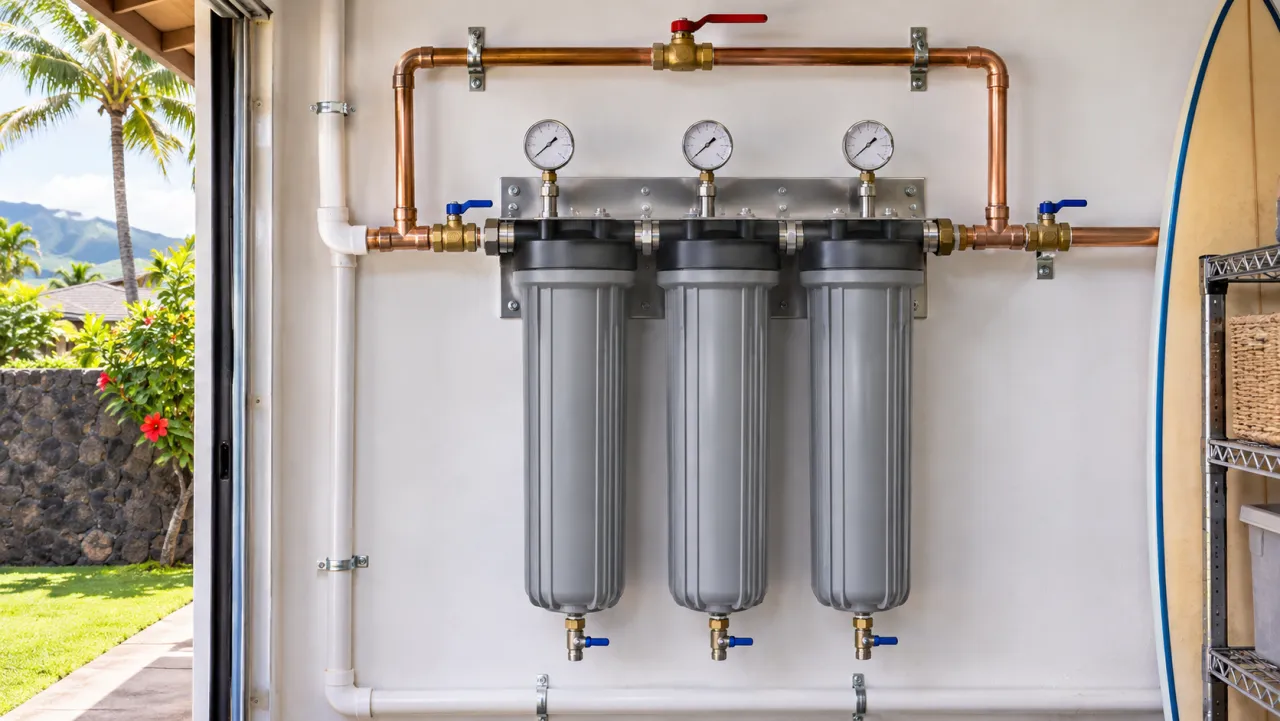
The point-of-entry stage is where a good whole house filter earns its place. Large 20-inch housings hold more media, so they clog more slowly and keep up with a full household. Pressure gauges tell you when to change cartridges, and drain valves make each change faster and cleaner, which matters when you change filters every few months.
The SILVATTI FILTRI is a three-stage whole house system with 20-inch housings, 1-inch connections, 15 gallons per minute of flow, four pressure gauges and three drain kits. On a catchment home it can hold your sediment and carbon stages ahead of a UV unit. We help you choose the cartridges for your water.
If you are on county water instead, read our Maui tap water guide or our guide on how to choose a whole house water filter.
Questions about your catchment system? Contact us and tell us about your tank, pump and current filters.
Sources: Hawaii State Department of Health, Safe Drinking Water Branch; University of Hawaii at Manoa, College of Tropical Agriculture and Human Resources, Guidelines on Rainwater Catchment Systems for Hawaii and “Filters for Rainwater Catchment Systems.”
Published November 9, 2026
Back to Blog